






Cooking a turkey is a well-established custom for Thanksgiving. But have you ever experimented with a salt encrusted turkey recipe? If not, then you should give it a go this season for a remarkable Thanksgiving turkey encounter.
Before I proceed to share the salt-coated turkey recipe with you, let me elucidate its meaning. A salt crust is a technique of preparing an ingredient such as turkey, fish, or chicken in salt, water, and egg blend. This aids in preserving the moisture and flavors during the cooking process.
This method results in an incredibly succulent turkey breast. If you choose to utilize this method, you don’t need to brine the turkey as it accomplishes the same objective.
In addition to maintaining the turkey’s tenderness and juiciness, salt encrusting also retains its warmth for approximately 30 minutes post-roasting. You can break the salt layer just before carving your turkey. This turkey cooking recipe requires 30 minutes of preparation.
Different Thanksgiving Dishes To Experiment With
- chef john’s roast turkey and gravy
- chef john’s make ahead turkey gravy
- Leftover Turkey Hash
- Alton Brown’s Classic Brined And Roasted Turkey
- Apple Cider Brined Turkey
- BBQ Turkey
- Turkey Sandwich
- Turkey Melt
- Hot Turkey Sandwich
- Turkey And Cheese Sandwich
Which Tools Are Required To Create Salt Encrusted Turkey?
- Blade – You will require a poultry blade to eliminate the turkey’s backbone.
- Chopping Board – A chopping board will aid in deboning the turkey and dicing vegetables.
- Frying Pan – A frying pan will be employed to roast the turkey.
- Baking Device – An oven or a barbecue is necessary for roasting the turkey.
- Temperature Probe – A thermometer is needed to verify the turkey’s temperature for its readiness.
- Large Ladle – A large ladle will be utilized to break open the salt crust.
- Baking Brush – A baking brush will be needed to eliminate the surplus salt.
What’s the Time Investment for Making Salt Encrusted Turkey?
| Preparation Time | Total Time |
|---|---|
| 30 Minutes | 2 Hours |
What Elements Are Essential for Making Salt Encrusted Turkey?
- Turkey Chest – To create a salt-encrusted turkey, you will need a fresh turkey with a 5 to 6 lb skin.
- Sunflower Oil – No recipe is complete without some oil. As a result, you will require two teaspoons of sunflower oil to rub on the turkey chest.
- Rock Salt – Salt encrusting necessitates a significant amount of salt. You will need three lbs (approximately 10 cups) of coarse rock salt, like Diamond Crystal.
- Chicken Whites – The salt encrusting mix consists of egg whites. You will need six big egg whites.
- Fluid – This blend also needs water. Therefore, you will require one-fourth cup plus five tablespoons of water.
- Allium – To infuse an umami essence, you will need a big allium, halved lengthwise, to place next to the salt blend.
- Parsley – Fresh herbs like six (6-inch) parsley twigs will also be utilized to add fresh and earthy notes.
- Verbena – To incorporate a minty hint, you will need six (6-inch) verbena twigs.
- Rosemary – Six (6-inch) rosemary twigs are necessary to provide hints of evergreen and citrus.
- Sage – For earthy notes, you will require six (6-inch) sage twigs.
- Black Pepper – For garnishing the turkey, freshly cracked black pepper is required.
- Gravy – To serve the turkey, turkey gravy is indispensable.
Procedures To Prepare Salt Encrusted Turkey
1. Prepare The Turkey
Initiate the oven heating to 400°F. Lay the turkey on a cutting board, chest facing downwards. Employing a poultry blade, take out the backbone from the turkey. You can reserve it for making broth or dispose of it.
Flip the turkey with the chest facing upwards. Press strongly with your palms on the turkey chestbone until it breaks, and the turkey chest flattens
Trim the extra fat and skin around the turkey’s neck.
Commence at the neck side of the turkey, elevate and release the skin from the breast by softly sliding the fingers and pushing inwards between the skin and flesh. Take care not to separate the skin. Rub one teaspoon of olive oil beneath the turkey skin on the breast area and massage the remaining teaspoon of oil onto the skin.
2. Arrange The Salt Coating
Mix salt and egg whites in a large bowl. Add a quarter cup of water to the egg and salt blend and keep stirring.
Add the rest of the water, one tablespoon at a time, until the consistency of the mix resembles powdery snow or slightly damp sand. Shape the salt mix into a small sphere using your hands for an accurate texture evaluation. If it holds form in hand but crumbles if dropped into a bowl, you have attained the correct texture.
3. Turkey Encased in Salt
In a 12-inch cast-iron pan, arrange two cups of the salt blend in a pile, leaving a 2-inch gap around the pan’s borders. Position one halved shallot, cut sides facing up, in the salt blend within the pan. Add two sprigs each of parsley, thyme, rosemary, and sage on top.
Position the turkey with the skin side down on the salt mixture with herbs. Cover the turkey with the remaining salt mix. Firmly press the salt mix, making sure to fill the cavity around the turkey’s neck and cover the sides.
You can also place a trimmed wooden skewer in the turkey instead of a thermometer before adding the salt covering. To monitor the turkey’s temperature, withdraw the skewer and insert a meat thermometer. Reinsert the skewer and continue roasting if necessary.
Bake the turkey for 1 hour and 25 minutes in the preheated oven until the thermometer shows 150°F. Take out the cooked turkey from the oven. Allow the roasted turkey to rest for 10 to 15 minutes. The turkey will keep cooking from the heat retained inside the salt crust and reach an internal temperature of 165°F.
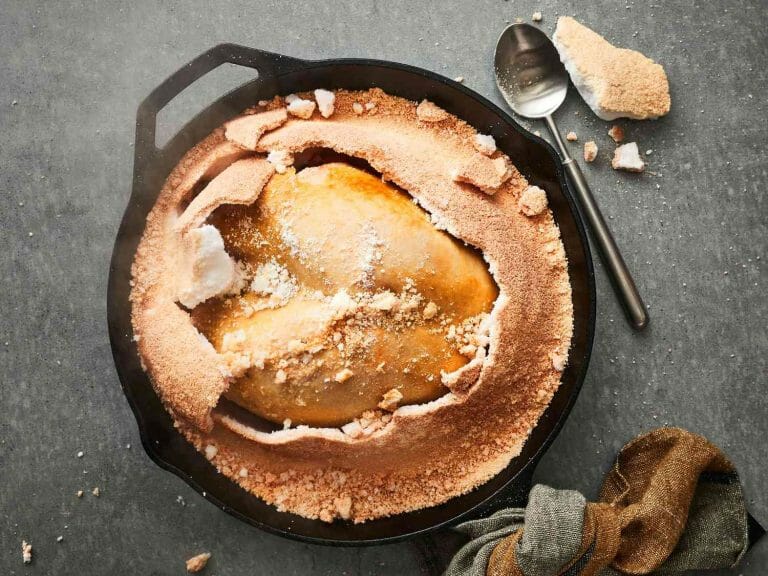
Utilize the back of a large spoon to fracture the salt crust on the turkey. Remove the salt crust in fragments and softly brush off any surplus salt. Eliminate and discard the skin. Carve the turkey and put it on a serving dish. Adorn the turkey with the remaining herb twigs and black pepper. Serve with gravy on top.
How To Keep Remaining Salt Coated Turkey?
Now that your salt covered turkey is prepared, you may contemplate how to handle the leftovers. Similar to regular roasted turkey leftovers, you can store the turkey in an airtight container after removing the salt coating. Place this container in the fridge for two to four days.
Nutritional Details
| Calories | 21 kcal |
| Fat | 1 gram |
| Saturated Fat | 0.2 grams |
| Polyunsaturated Fat | 0.2 grams |
| Monounsaturated Fat | 1 gram |
| Protein | 1 gram |
| Cholesterol | 0.1 milligrams |
| Fiber | 0.3 grams |
| Sodium | 87916 milligrams |
| Carbohydrates | 1 gram |
| Potassium | 57 milligrams |
| Sugar | 0.4 gram |
| Calcium | 68 milligrams |
| Iron | 1 milligrams |
| Vitamin A | 132 IU |
| Vitamin C | 3 milligrams |
Appearance and Flavor of Salt-Crusted Turkey
Preparing a salt-crusted turkey is a fantastic option to try this Thanksgiving season. The salt crust and spices impart a wonderful taste and crispy surface to the turkey. Furthermore, it helps keep the turkey juicy and tender. When you break open the salt crust, you are greeted with a fragrant herbal aroma.
Card with Recipe
Recipe for Salt Crusted Turkey
Try this simple and unique salt-crusted turkey recipe for an exceptionally moist and tender turkey this Thanksgiving.
Preheat the oven to 400°F. Place the turkey on a cutting board, breast side down.
Utilize a poultry knife to detach the backbone from the turkey. You can keep it for producing stock or discard it.
Flip the turkey breast side up. Apply pressure on the turkey breastbone until it cracks, using your hands’ heels, and slightly flatten the turkey breast. Get rid of the unneeded turkey fat and skin around the neck.
Begin from the turkey’s neck area, lift and separate the turkey’s skin from the breast by gently pushing your fingers and sliding between the skin and flesh. Ensure not to detach the skin.
Include the remaining water, one tablespoon at a time, until the mixture’s consistency resembles snowy powder or slightly damp sand. Mold the salt blend into a small sphere using your hands for the correct texture evaluation. If it holds its shape in hand but crumbles when placed in a bowl, you have achieved the right texture.
In a 12-inch cast-iron pan, arrange two cups of the salt mix in a pile, leaving a 2-inch gap around the pan’s borders.
Position one halved shallot, cut sides facing upwards, in the salt mixture within the pan. Garnish it with two sprigs each of parsley, thyme, rosemary, and sage.
Place the turkey with the skin side on the salt crust and herb mix. Cover the turkey with the rest of the salt mixture. Press the salt mix firmly, ensuring it fills the cavity around the turkey’s neck and covers the edges.
Put a probe thermometer in the thickest portion of the turkey chest. Apply pressure to close the crevices or any openings in the salt shell, creating a firm seal around the thermometer.
Patiently yet assertively push the salt blend into the turkey chest. Smooth the exterior to mend any crevices or openings.
Bake the turkey for 1 hour and 25 minutes in the preheated oven until the thermometer shows 150°F.
Take out the cooked turkey from the oven. Allow your cooked turkey to rest for 10 to 15 minutes. The turkey will keep cooking from the heat trapped within the salt shell and reach an inner temperature of 165°F.
Using the reverse side of a large spoon, break the salt layer on the turkey. Remove the salt crust in fragments and delicately remove any excess salt. Eliminate and discard the skin.
Carve the turkey and position it on a serving dish. Adorn the turkey with remaining sprigs of herbs and black pepper.
Present with a layer of gravy.
couverte.
Frequently Asked Questions (FAQs)
What are the advantages of salt crusting turkey?
Salt crusting on a turkey keeps the meat succulent and tender.
Why are egg whites employed in salt crust?
Using egg whites helps secure the salt and avoid it from penetrating the food. It also contributes to homogeneous food cooking.
Which salt type do you choose for salt crust?
Kosher salt (Morton or Diamond) is the ideal choice for salt crusting.
Is it necessary to let the turkey settle after applying the salt crust layer?
No, you do not need to let the turkey rest after using the salt crust layer. You can roast it promptly.
Final thoughts
I trust you relished discovering this modern method of roasting a turkey. Experiment with it this Thanksgiving season, and share the outcomes in the comments section below.